
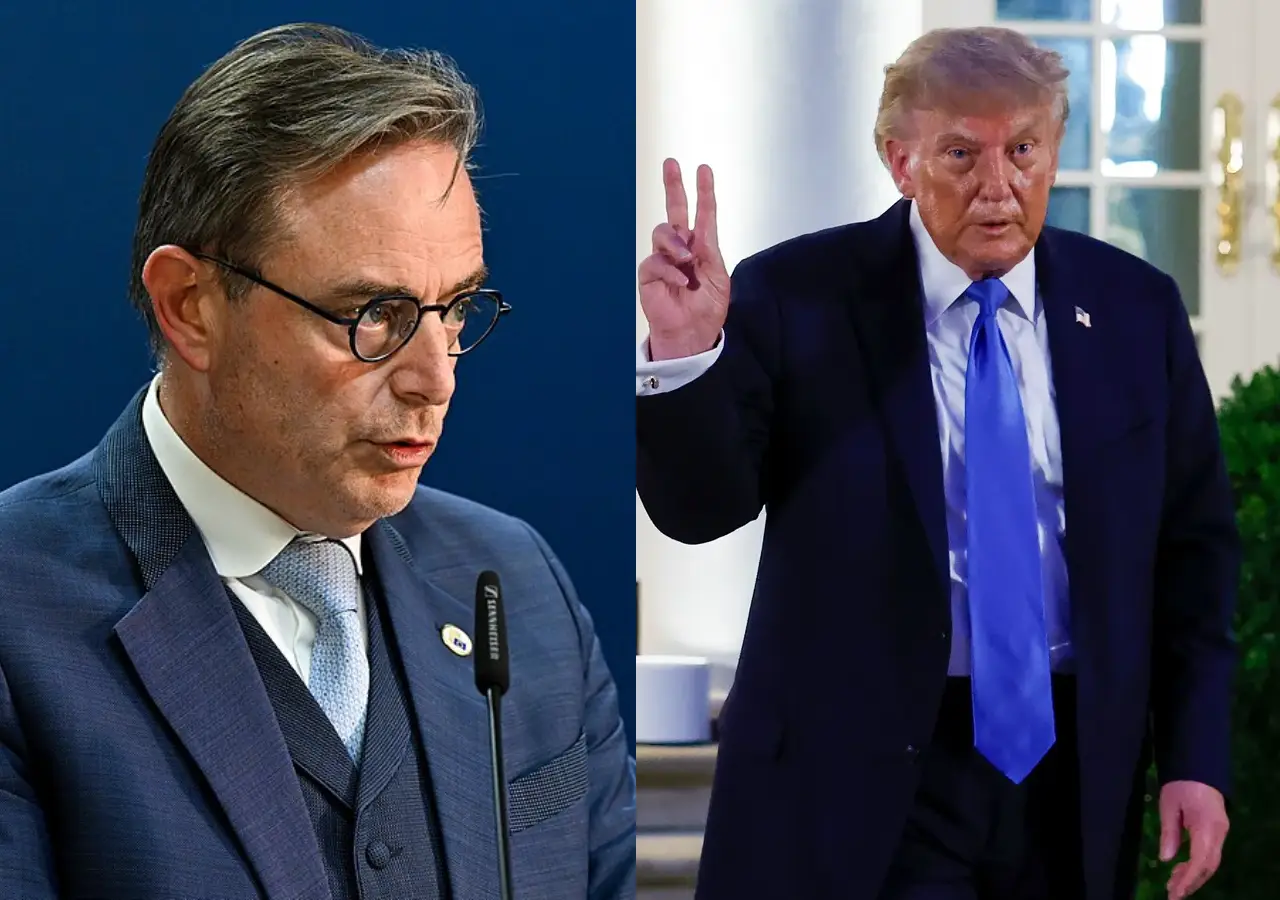
Belgian Prime Minister Bart De Wever spoke during his visit to India today about one of the biggest challenges facing global trade the growing use of tariffs and trade barriers. Speaking in Mumbai, De Wever criticised what he described as “arbitrary” decisions related to tariffs. His remarks clearly appeared to point toward US President Donald Trump’s approach to international trade. He did not directly mention Trump, but his comments on tariffs were clearly evident.
While speaking at an event focused on the India-European Union Free Trade Agreement, he said the world should move towards reducing trade barriers and creating more reliable economic relationships rather than shutting markets. His message was clear: if companies are expected to invest, manufacture and trade across borders, there should be stability and clear rules.
In recent years, tariffs have become an integral part of the global economic scenario. Governments often use them to protect domestic industries or gain an advantage in trade negotiations. However, frequent changes in tariff policies can make it difficult for businesses to plan. A company needs a clear set of rules for its ventures, as deciding to set up its project needs proper planning.
This is where De Wever’s criticism becomes important. His concern seems to be more about uncertainty and less about tariffs. When companies have clear information, they can sometimes adjust to higher costs and make the necessary changes. The real problem is when they do not know whether the existing tariff rules will remain the same in the near future or will be changed further. The Belgian prime minister pointed to the India-EU trade agreement as an example of a different approach. The main purpose of this kind of agreement is to set clear rules for both parties. This can make it easier for businesses to plan and explore new markets. IT also highlights the growing economic relationship between India and Europe at a time when there are erratic Global trade patterns.
As this agreement creates new opportunities for European businesses, India has become an increasingly important partner for European countries. Because of its large market, growing economy, expanding industrial base, and stronger ties with Europe. These things eventually help Indian companies to gain access to more customers, investment, and technology.
For Belgium, there others reasons for strengthening ties with India. Both countries are discussing cooperation in areas such as trade, defence, clean energy, technology and critical minerals. Because both countries try to reduce their dependence on a limited number of markets for their supply chain.
De Wever’s comments come at a time when Europe is rethinking how it should manage its economic relationships with the world’s major powers. The pandemic, geopolitical tensions, and disruptions in supply chains have shown how quickly problems in one part of the world can affect businesses in another. As a result, European governments are paying more attention to economic security while also looking for new and reliable trading partners.
India naturally fits into this changing landscape. India’s relationship with Europe is no longer limited to traditional trade in goods. There is growing interest in areas such as investment, technology, manufacturing, energy and strategic industries. Stronger ties between India and the European Union could therefore create benefits for both sides.
At the same time, De Wever’s comments should not be seen as a major confrontation with Washington. European countries continue to maintain deep economic and political ties with the United States. His remarks are better understood as part of a wider discussion about how international trade should work at a time when the use of tariffs is becoming increasingly common.
India naturally fits into this changing landscape. India’s relationship with Europe is no longer limited to traditional trade in goods. There is growing interest in areas such as investment, technology, manufacturing, energy and strategic industries. Stronger ties between India and the European Union could therefore create benefits for both sides.
The message is not obscure. At the same time, De Wever’s comments should not be seen as a major confrontation with Washington. European countries continue to maintain deep economic and political ties with the United States. His remarks are better understood as part of a wider discussion about how international trade should work at a time when the use of tariffs is becoming increasingly common.
The biggest concern is unpredictability. Because investments involve large amounts of money and may take several years to generate returns, businesses need clear and stable rules to make long-term decisions. Sudden changes in trade policy can increase costs and make it harder for companies to make clear decisions.
For India, this situation presents an opportunity. As countries look to diversify their trading relationships, India can strengthen its position by building closer economic ties with Europe and other major markets. If the India-EU trade agreement leads to greater trade and investment, it could play an important role in this process.
De Wever’s comments during his India visit therefore carry a simple message. In today’s time when global trade is becoming increasingly unpredictable, countries may benefit from building clear and reliable partnerships instead of relying too heavily on sudden policy changes. The comment about arbitrary tariffs may have been an indirect reference to Trump, but the broader point is something businesses around the world understand well: when the rules are clear, planning becomes easier.
The coming years will show how India and Europe use their growing economic relationship. For now, De Wever’s visit highlights a straightforward point in an uncertain global economy, stable trade partnerships can benefit everyone.




4 thoughts on “Belgian PM Takes Indirect Dig at Trump’s ‘Arbitrary’ Tariffs”